

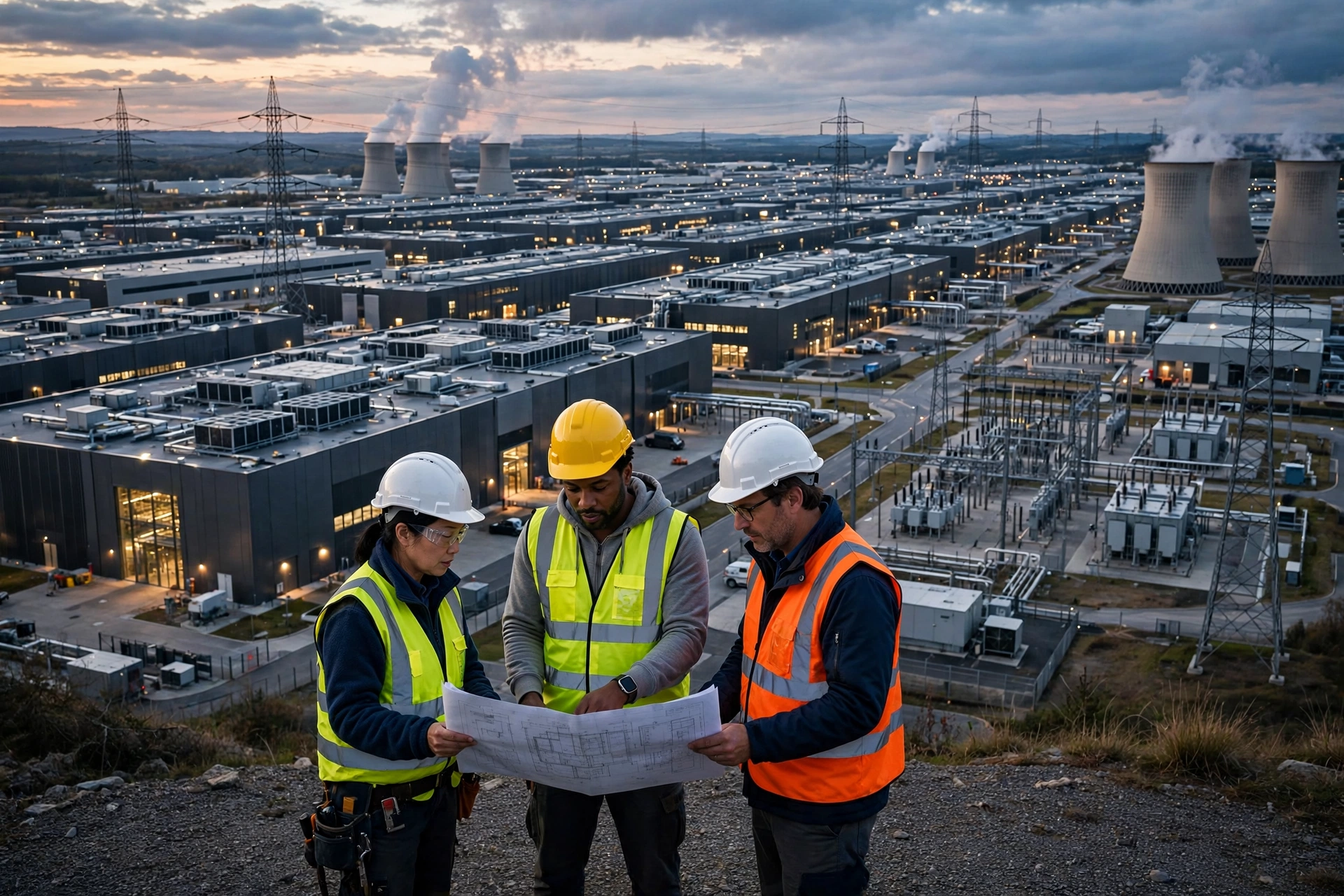
The artificial intelligence boom has a price tag, and a new analysis has put it in terms almost anyone can grasp: paying for the data centres now being planned would take the combined pay of roughly 250 million jobs, in a country, the United States, that employs about 159 million people. The comparison, drawn from an analysis published by PostQuantum, underlines a question that investors, utilities and governments are all starting to ask at once: does the maths behind the AI building boom actually add up?
An Infrastructure Bill Unlike Any Other
Technology giants and their partners have announced data centre commitments on a scale that dwarfs previous waves of computing investment. Campuses that once would have been considered enormous are now routine, and the largest projects are measured in gigawatts of power and tens of billions of dollars each. Chips, land, cooling, grid connections and backup generation all have to be paid for years before the facilities earn anything, and much of the spending is financed with borrowed money. As The Register reported this week, forecasts now show infrastructure spending racing ahead of the revenue the industry expects AI services to generate in the near term.
The 250 million jobs figure is a thought experiment, not a payroll. It takes the announced cost of building and equipping the coming wave of AI facilities and divides it by typical wages, showing that the capital being mobilised rivals the entire annual earnings of a workforce far larger than America’s. In other words, society is committing resources to AI infrastructure at a pace comparable to employing every worker in the country, and then some, for a year.
Why Companies Keep Spending Anyway
Executives defend the outlay with a simple argument: demand for computing power is growing faster than supply, and the cost of being caught without capacity is higher than the cost of building too much. Every major provider points to waiting lists for advanced chips, sold-out cloud capacity and enterprise customers eager to deploy AI tools. There is also a strategic fear at work. In a race where scale is widely believed to decide the winner, no board wants to explain why it held back while rivals built.
History offers both encouragement and warning. The fibre-optic boom of the late 1990s bankrupted many of its builders, yet the networks they laid later carried the modern internet at bargain prices. Railways followed a similar pattern a century earlier. Overbuilding can ruin the investors who fund it while still leaving society better off, a distinction that matters greatly if you own the shares but rather less if you simply use the technology.
The Power Problem Behind the Money Problem
Money is not the only constraint. Data centres need electricity in quantities that strain local grids, and several regions have slowed or paused new connections while utilities work out how to supply them. Projects increasingly come with their own power strategies, from new gas plants to restarted nuclear facilities and vast solar farms. Communities near proposed sites are asking harder questions about water use, noise and who benefits from the jobs created, which tend to be far fewer once construction ends than the headline investment might suggest.
For smaller businesses watching from the sidelines, the practical effects are already visible in the price and availability of cloud services. The same wave of investment is also why tools that once required an IT department are now available off the shelf, as we noted in our guide to AI website builders for small businesses. And as organisations move more of their operations into these facilities, the basics matter more than ever, including the habits covered in our explainer on understanding password managers.
What Happens If the Revenue Arrives Late
The risk scenario is straightforward. If AI revenue grows more slowly than the spending assumes, the industry will be left with expensive facilities, heavy debts and pressure to cut prices, squeezing returns for years. Chip suppliers, construction firms and energy companies would feel the slowdown first, followed by the cloud providers themselves. The optimistic scenario is equally simple: demand keeps doubling, the facilities fill as fast as they open, and today’s alarming forecasts come to look conservative.
Either way, the sheer scale of the commitment guarantees that AI data centres will remain one of the defining business stories of the decade. When a single industry’s building programme can be sensibly compared with the pay of 250 million workers, it has stopped being a technology story alone. It is now an economic one, and everyone, from investors to electricity customers, has a stake in how the maths finally resolves.
