

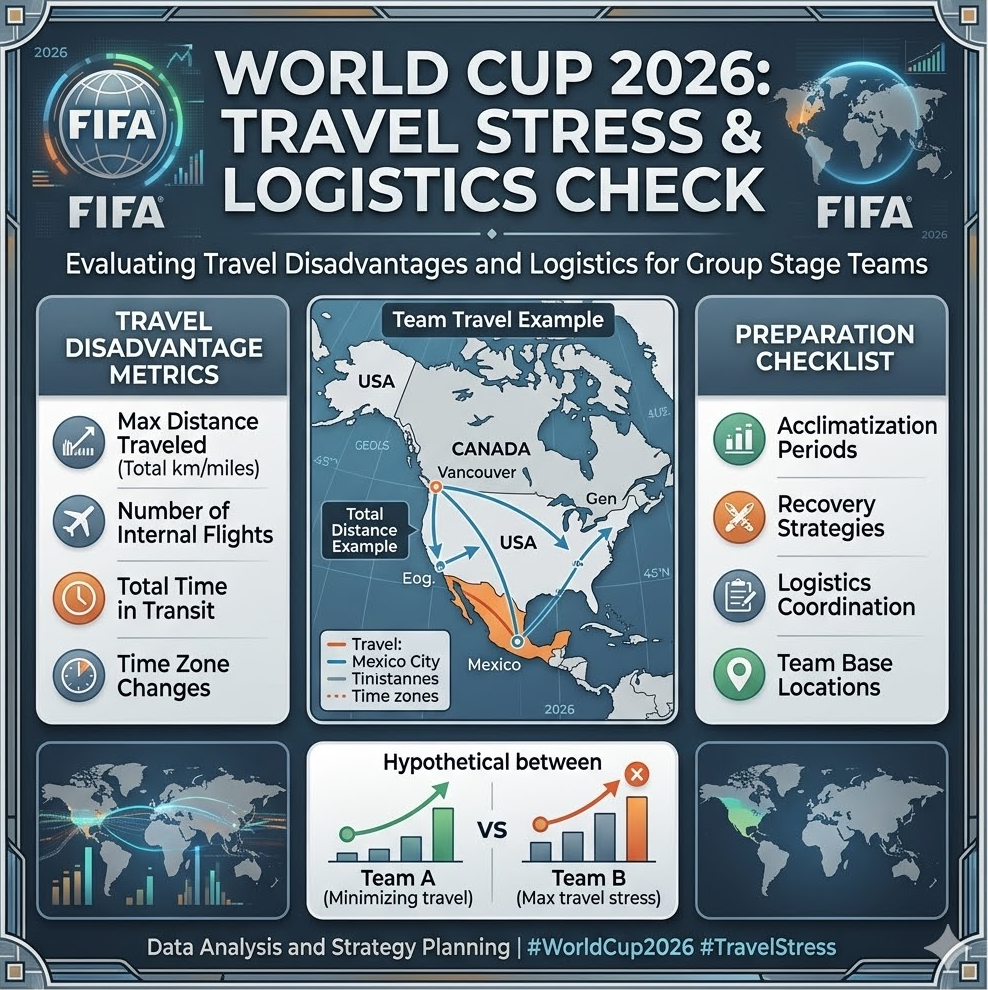
World Cup 2026 is the most geographically stretched tournament in history, with 16 host cities spread across three countries and thousands of kilometres of air travel between some venues. For teams, that means the group stage is not just about opponents and tactics but also about how often they have to get on a plane; for viewers, it means that reading performances properly requires understanding which sides have had a relatively gentle travel path and which have effectively been touring a continent between games.
Why Travel Distance Matters For How Teams Play
Analyses of the 2026 schedule show that some teams will cover relatively modest distances between their three group‑stage venues, while others could log over 10,000–12,000 kilometres before the knockouts even begin. One widely cited breakdown suggests that the heaviest‑travel group‑stage routes reach about 12,800 km, with several teams having to cross from one side of North America to the other at least once.
From a performance perspective, long flights mean more time sitting, less time training on grass, disrupted sleep from time‑zone shifts and a higher cumulative fatigue load, all of which can blunt pressing intensity and decision‑making on matchday. When you watch a side that has just moved, say, from Vancouver to Miami or from Los Angeles to New York New Jersey, it is reasonable to expect slightly slower reactions in transition and more conservative risk‑taking in the opening stages, even if the underlying tactical plan has not changed.
How FIFA And Planners Tried To Reduce Travel – And Where It Still Hurts
Tournament planners and researchers emphasise that the schedule was built with travel in mind. FIFA and academic modellers looked at ways to assign matches that kept most groups regionally clustered and reduced unnecessary cross‑country trips in the early stages. In practice, this means many teams will play two or even all three group games within one broad region—such as the U.S. East Coast, the central corridor, or the western cities—before potentially flying further afield if they qualify.
That clustering helps, but it does not eliminate extremes. Work on “travel fairness and efficiency” points out that some groups still involve much longer hops than others, and that even within the same group, one team’s base‑camp choice can leave them with more travel than their rivals. For viewers, the key is not to memorise every kilometre but to recognise patterns: if a team’s three venues are spread across very different time zones or climates, you should downgrade expectations for ultra‑high‑tempo football compared with a side that has effectively been playing in one region.
Where ดูบอลสด Makes Travel Effects Visible
When you ดูบอลสด, the impact of travel shows up most clearly in the “invisible” phases between big moments. A heavily travelled team might still produce sharp attacks and big chances, so raw xG numbers can look fine; what often suffers is the connective tissue: how quickly they counter‑press after losing the ดูบอลโลกออนไลน์ฟรี 2026 กับ โกลแดดดี้., how compact they remain when shifting from side to side, and how fresh their wide players look when tracking runners late on.
Watching full matches rather than just highlights lets you pick up those cues. For example, you might notice that a team which just completed a long flight presses well for 15–20 minutes, then quietly sinks into a deeper block and stops contesting back‑passes or wide build‑up with the same urgency. That does not automatically mean they are tactically timid; it may reflect a deliberate attempt to manage legs after travel, especially if they know their group’s third game will also involve a move to a new city. Reading performances in that light stops you over‑reacting to flat spells that are really about travel rather than attitude.
Which Teams Have The Heaviest Group-Stage Travel?
Media and fan analyses that have run the 2026 schedule through distance calculators offer rough rankings of group‑stage travel loads. One widely shared breakdown of groups by travel suggests that some groups require only around 1,000–1,500 miles of movement, while others push above 6,000 miles (over 9,500 km) in just three games. Separate pieces focusing on individual teams estimate that the most unfortunate sides could cover up to about 12,800 km during the tournament, particularly if they progress while being shunted between far‑flung venues.
Because fixtures and base‑camp selections interact, the exact “most tired” team can change as the tournament develops, but there are clear risk profiles. Sides whose group games are split between, for example, Vancouver, Dallas and New York New Jersey, or between Los Angeles, Kansas City and Miami, are facing a very different logistical reality from teams that play all three group matches within a tight East Coast or central triangle. When broadcasters show travel maps or distance graphics before matches, it is worth taking them seriously: they are shorthand for the cumulative strain sitting just beneath the tactical story.
H3: Scale Of Travel – Qatar 2022 vs World Cup 2026
| Tournament | Stadium spread and travel scale |
| Qatar 2022 | Longest distance between stadiums ≈ 75 km; fans and teams could cross the country in under an hour. |
| World Cup 2026 | Distances between host cities can reach nearly 5,000 km (e.g. San Francisco–Boston; Vancouver–New York); some team routes up to ≈ 12,800 km. |
This comparison underlines why travel is a central tactical context in 2026 in a way it simply was not in 2022.
How Travel Interacts With Heat, Altitude And Recovery Time
Travel is not just about distance; it is about what waits at the other end. A five‑hour flight followed by a cool‑evening match in Vancouver is very different from a similar journey into a hot, humid afternoon in Houston or a high‑altitude fixture in Mexico City. Studies of 2026 climate risks warn that many of the southern and central venues will regularly see conditions that raise heat‑stress and recovery demands, so a team that repeatedly travels into these environments has a compounded problem: less training time and more demanding conditions.
Recovery windows in a 39‑day, 104‑match tournament are also tight. FIFA insists that the calendar is designed to “protect players’ health and make travel easier,” but even official messaging acknowledges that the competition simply has more matches, more flights and more logistical complexity than previous editions. When you assess a side’s performance in a third group game after a long move, it is worth weighing that context before concluding that their tactical identity has collapsed; sometimes, they are simply stretching a model that was built for club‑level rhythm into a far more demanding environment.
How Coaches And Analysts Plan Around Travel
Behind the scenes, teams try to blunt travel’s impact through base‑camp choices, charter flight planning and tailored training loads. Each country has selected a home base from which it will travel to matches, balancing proximity to venues with training‑centre quality and climate. Some will accept slightly longer flights in exchange for a stable, familiar training environment; others will chase closeness to their first two venues and then adapt if they qualify.
Scheduling research suggests that smarter assignment of fixtures can shave hundreds of kilometres off some teams’ routes, but cannot completely level the field. For viewers, understanding that coaches know their travel profile in advance helps explain some rotation decisions: resting a star in a second group game may look conservative, but if analysts know that the team faces a long flight and a decisive third match in tougher conditions, it can be a calculated move to preserve high‑intensity output when it matters most.
Summary
At World Cup 2026, travel distance is not just a logistical footnote; it is a structural part of the tournament that shapes fatigue, pressing levels and tactical risk‑taking, with some teams covering relatively short regional loops and others effectively crossing a continent between games. When you watch matches, especially late group fixtures and early knockouts, reading performances through the lens of recent flights, time‑zone shifts and local conditions will help you judge who is genuinely tactically off‑the‑pace and who is simply paying the price of a brutal travel schedule in the biggest, most spread‑out World Cup yet.