

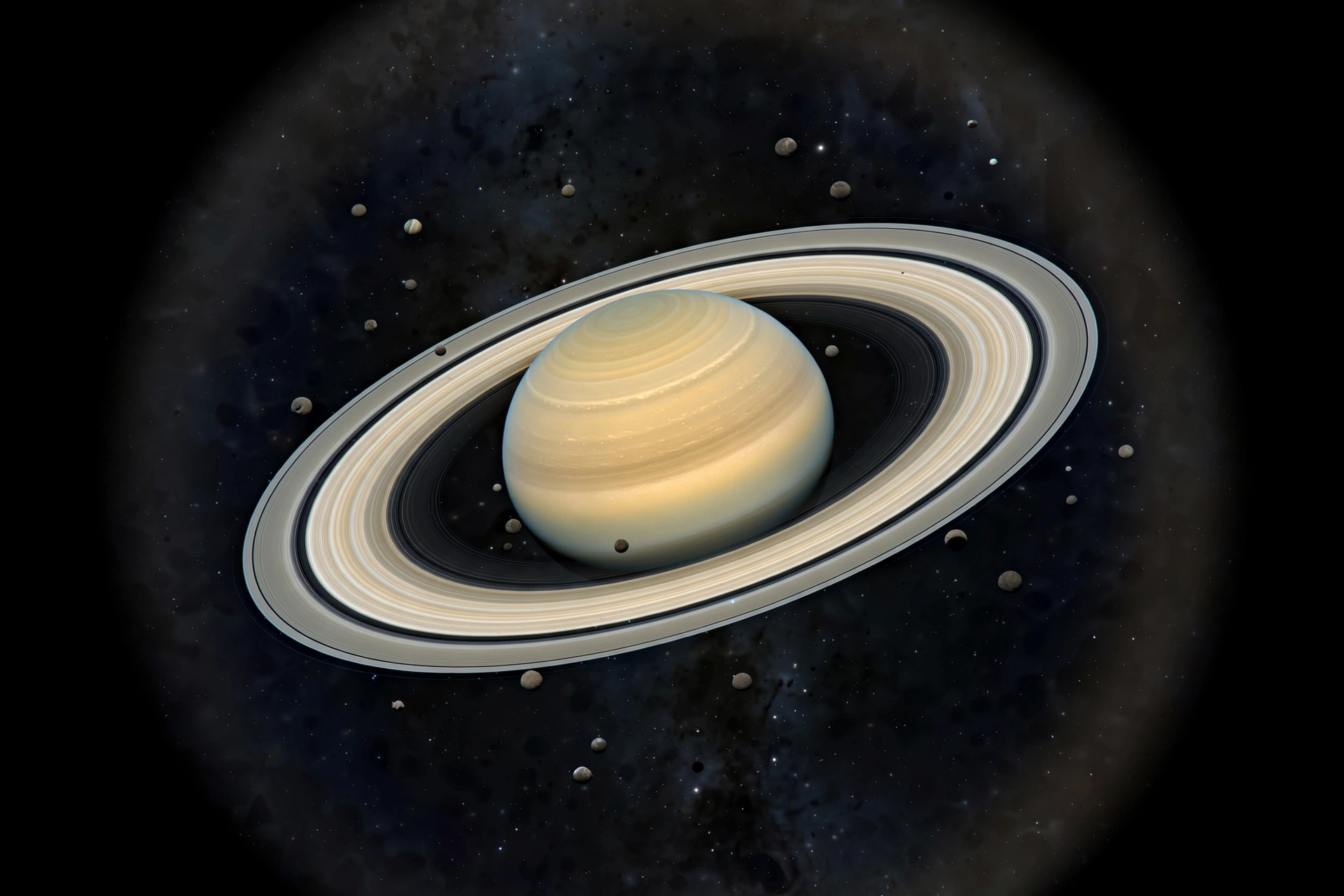
A Hawaiian telescope, a Canadian-French survey and years of careful tracking have changed the record books. Saturn now has 274 confirmed moons after scientists added 128 small, distant companions to the official list.
The find sits nicely alongside other recent space coverage, including our report on the SpaceX jellyfish cloud, which shows how much of modern astronomy is about noticing faint details at the edge of visibility and then following them with discipline until they give up their secrets. Saturn rewards exactly that kind of attention.
How the faint moons were found
The new moons were uncovered using the Canada-France-Hawaii Telescope, whose sharp images allowed the team to combine many exposures and reveal objects far too faint to notice in a single frame. Colleagues at the University of British Columbia helped to track the candidates over time, confirming which specks were genuinely travelling with Saturn rather than passing asteroids or distant background stars. Readers can explore the university’s wider research through the University of British Columbia, whose astronomers have played a central role in mapping the outer planets and their retinues.
Fragments with a violent past
Most of the newcomers are irregular moons. Unlike large, familiar moons that circle close to a planet’s equator, irregular moons follow wide, tilted and often backwards orbits. Astronomers believe many are fragments of larger bodies that collided long ago, or captured objects drawn in by Saturn’s gravity early in its history. Each tiny survivor is therefore a clue, preserving evidence about collisions and migration in the young solar system that larger, tidier moons cannot provide.
Why formal recognition matters
Recognition matters as much as discovery. A moving dot becomes a moon only after its orbit has been measured well enough for other astronomers to find it again, and the new batch has now received formal recognition through the International Astronomical Union’s processes. That bureaucratic step is what turns an intriguing observation into a permanent entry in the catalogue, and it is why the headline figure of 274 can be stated with confidence rather than as a provisional estimate.
A map of home, still unfinished
Why does Saturn collect so many small companions? Its distance from the Sun, its powerful gravity and its history of collisions all help. Debris that might elsewhere drift away can remain bound to Saturn for billions of years, slowly spreading into families of fragments that share similar orbits. Studying those families lets researchers rewind the tape, estimating when a parent body broke apart and how violent the original impact must have been.
Clues to how planetary systems form
The announcement also underlines how incomplete our map of home remains. If 128 moons could hide around one of the most watched planets in the sky, smaller and darker objects almost certainly await discovery around Saturn, Uranus and Neptune. Better cameras, smarter software and longer surveys will keep redrawing the league table, although Saturn’s lead is now so large that overtaking it would require an extraordinary find elsewhere.
What astronomers will look for next
For the casual stargazer, none of the new moons will be visible through a backyard telescope; they are simply too small and too faint. Their value is scientific rather than visual. Together they turn Saturn into a natural laboratory for understanding how planetary systems assemble, collide and settle, and they remind us that even familiar planets still guard secrets in plain sight, waiting for a patient enough survey to notice them.
For anyone building explainers or classroom resources from this news, the cleanest framing is simple: Saturn is a planet with a population. Some members are large enough to have geology and weather; most are rubble-sized witnesses to ancient break-ups. Teaching both scales together gives students a truer picture than a portrait of the rings alone.
A quiet record, firmly set
So the solar system’s most decorated planet has become more decorated still. Saturn’s 274 moons will not change what you see on a clear night, but they will change textbooks, catalogues and the questions researchers ask next. Somewhere in that faint swarm are fragments of ancient collisions and captured wanderers from the early solar system — small worlds, newly named in effect if not yet in name, that have been circling Saturn unseen for billions of years, waiting for us to catch up.
