

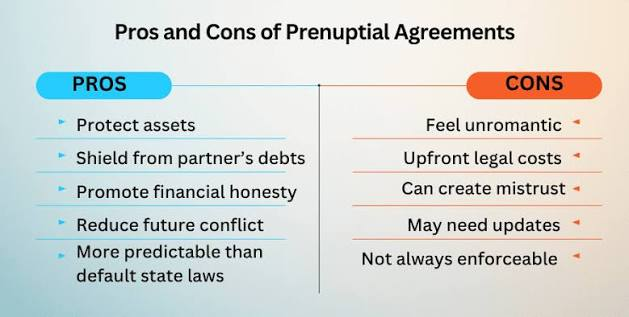
When couples approach marriage, financial planning rarely receives the same attention as venue booking or guest lists. Yet the decisions made before a marriage begins can shape how assets, debts, and obligations are handled for decades — or how they are divided if the marriage ends. Prenuptial agreements have become more common across income levels and age groups, partly because of increased awareness and partly because more people are entering second marriages or bringing established businesses, real estate, or retirement accounts into a new union.
The problem is that the process of creating a prenuptial agreement has also become significantly more commercialized. Online legal platforms now offer downloadable prenuptial templates, often marketed as sufficient alternatives to professional legal counsel. For couples trying to manage costs or avoid what feels like an uncomfortable conversation with an attorney, these templates can seem like a practical shortcut. What those platforms rarely explain clearly is how US courts evaluate prenuptial agreements when they are contested — and why document format alone tells courts almost nothing about whether an agreement will hold.
Why the Enforceability Question Matters More Than the Document Itself
When a prenuptial agreement is brought before a court — whether during a divorce, a dispute over property, or an estate proceeding — judges do not simply review whether the document was signed. Courts conduct a more structured examination that looks at how the agreement was formed, whether both parties had adequate time to review it, whether each party understood what they were giving up, and whether independent legal counsel was involved. This is where the difference between working with qualified prenup lawyers and downloading a template becomes genuinely consequential.
The document itself is only one component. Courts in most US states apply a procedural and substantive review to challenged prenuptial agreements. Procedural fairness looks at how the agreement was negotiated and whether both parties entered it voluntarily. Substantive fairness examines whether the terms are grossly one-sided or unconscionable at the time of enforcement. An online template, filled out without legal input, typically cannot satisfy both of these standards under real scrutiny — not because the language is necessarily wrong, but because the process surrounding it is almost always incomplete.
The Role of Independent Counsel in Protecting Validity
One of the most consistent factors courts examine in contested prenuptial agreements is whether each party had access to independent legal counsel before signing. This does not always mean the agreement is automatically void if one party chose not to use an attorney, but it significantly weakens the enforceability argument when the agreement is challenged. If one spouse later claims they did not understand the terms or felt pressured to sign, the absence of their own counsel becomes a focal point for invalidation.
When prenup lawyers prepare or review an agreement for both parties separately, each attorney carries a professional obligation to explain the document’s implications to their respective client. That explanation creates a record — sometimes informal, sometimes documented — that the party understood what they were agreeing to. This type of procedural documentation is not something an online template generates, regardless of how comprehensive the form language appears to be.
How Courts Evaluate Financial Disclosure Requirements
US courts consistently require that prenuptial agreements be preceded by a fair and reasonable disclosure of each party’s financial position. This means both parties should have had access to a reasonably accurate picture of what assets, liabilities, income, and obligations the other person was bringing into the marriage. Without that disclosure, courts may treat any waiver of rights within the agreement — such as waiving spousal support or rights to certain property — as uninformed and therefore unenforceable.
Online templates do not prompt or manage financial disclosure processes. They provide blank fields for asset listing, but nothing in the template structure confirms that both parties actually reviewed each other’s finances before signing. In contrast, attorneys working on a prenuptial agreement will typically prepare or request financial disclosure schedules and ensure that the exchange of that information is documented. That documentation matters if the agreement is later challenged in court.
What Online Templates Actually Provide — and Where They Fall Short
Online prenuptial templates are, at their core, standardized form documents. They reflect general contract language that may be legally accurate in a broad sense but is not tailored to the laws of any specific state, the financial complexity of a particular couple, or the procedural standards that courts in different jurisdictions apply. The Uniform Premarital Agreement Act, which has been adopted in modified form by many states and is available through sources such as the Uniform Law Commission, establishes baseline standards — but state-level variations in how courts interpret and apply those standards are significant.
A couple in Georgia, for example, is subject to different case law precedents than a couple in California or New York. The way courts in those states have historically approached questions of voluntariness, unconscionability, and financial disclosure differs enough that a generic template cannot account for local judicial expectations. Prenup lawyers practicing in a specific state bring knowledge of how local courts have ruled on similar agreements — knowledge that directly informs how the document is structured and what provisions are included or omitted.
Terms That Templates Include but Courts May Reject
Many online templates include provisions that appear straightforward but that courts in various states routinely decline to enforce. Provisions that attempt to predetermine child custody arrangements or limit child support obligations, for instance, are generally unenforceable regardless of how they are worded, because courts retain independent authority over matters involving children. Similarly, provisions that attempt to govern personal conduct during a marriage — often called lifestyle clauses — vary dramatically in enforceability depending on jurisdiction.
A template has no mechanism to flag these issues. It presents clauses as options without explaining which ones are legally sound, which are jurisdiction-dependent, and which are unlikely to survive judicial scrutiny. A couple who includes an unenforceable provision in a template-based agreement may not discover the problem until years later, at which point the invalid clause may undermine confidence in other parts of the agreement as well.
The Timing and Execution Process in Court-Tested Agreements
Courts pay close attention to when a prenuptial agreement was presented and signed relative to the wedding date. An agreement signed one or two days before a ceremony raises immediate concerns about duress — the argument being that a party felt they had no realistic option to refuse or negotiate at that point. Attorney-managed prenuptial processes are typically structured to avoid this problem, with the agreement introduced and finalized well before the wedding to demonstrate that both parties had adequate time to reflect, consult, and revise.
Template-based agreements tend to be completed on whatever timeline the couple chooses, often without any guidance about how proximity to the wedding date affects enforceability. The execution process itself — notarization requirements, witness requirements, and state-specific signing formalities — also varies by state, and templates frequently include general instructions that may not fully align with the requirements of the state where the couple resides or intends to divorce.
The Specific Risks of Using Templates for Complex Financial Situations
For couples with straightforward financial profiles — minimal assets, no prior marriages, no business ownership, no significant debt disparities — a template-based agreement might create fewer immediate problems, though the procedural vulnerabilities described above remain. For couples with more complex circumstances, the limitations of templates become considerably more serious.
Business ownership creates valuation challenges that a template cannot address. If one spouse owns part of a business at the time of marriage, the prenuptial agreement may need to address how appreciation in that business value is treated during the marriage. Without careful legal drafting, a court may find that marital labor contributed to the business’s growth, making what was intended to be a separate asset subject to equitable distribution claims. Prenup lawyers working with business owners typically address this problem explicitly, using language calibrated to the type of business structure involved.
Similarly, couples with significant real estate holdings, retirement accounts, or inheritances anticipated during the marriage need provisions that account for the commingling risk — the legal concept by which separate property can lose its separate character if it becomes intertwined with marital assets. Template language rarely addresses these dynamics with the specificity courts expect when they are contested.
What Enforcement Actually Looks Like in Practice
When a prenuptial agreement is challenged during divorce proceedings, the spouse seeking to enforce it bears the initial burden of demonstrating that the agreement was validly formed. From there, the challenging spouse typically argues procedural defects — pressure, inadequate time, no independent counsel — or substantive defects — terms that were unfair or provisions that have since become unconscionable. Courts weigh these arguments against the record of how the agreement was created.
An agreement created with attorney involvement on both sides, preceded by documented financial disclosure, signed well before the wedding date, and tailored to state-specific requirements, presents a significantly stronger evidentiary record than a completed template signed at the kitchen table a week before the ceremony. That difference in process is ultimately what courts are evaluating — and it is a difference that no amount of careful template language can compensate for.
The choice between a template and professional legal counsel is, at its core, a decision about risk tolerance. The cost of attorney involvement in drafting a prenuptial agreement is real. But that cost is modest compared to the potential cost of an agreement that fails in court at precisely the moment it was meant to matter most.
Closing Thoughts
Prenuptial agreements serve a legitimate and practical function in financial planning for marriage. They allow couples to define how property is treated, clarify financial responsibilities, and reduce uncertainty in the event the marriage ends. Those goals are worth pursuing thoughtfully.
The online template market has made it easy to believe that creating a prenuptial agreement is primarily a matter of filling out the right form. What US courts have consistently demonstrated is that the validity of a prenuptial agreement depends far more on the process by which it was created than on the language the document contains. Voluntariness, disclosure, timing, independent counsel, and state-specific compliance are not features a template can provide — they are outcomes that require deliberate legal process.
Couples who understand this distinction make better-informed decisions. Whether they ultimately work with an attorney or not, knowing what courts actually examine when these agreements are challenged allows them to approach that decision with realistic expectations about what they are getting and what they may be giving up.
