

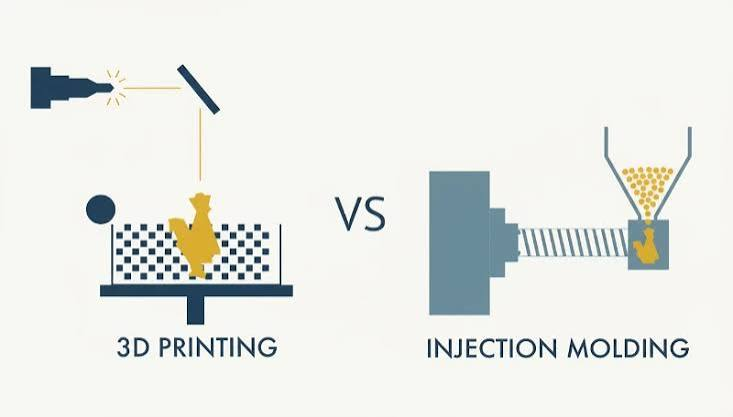
When a product development team needs a flexible, rubber-like component for functional testing, the manufacturing process they choose affects far more than just the part itself. It shapes the timeline, the budget allocation, the number of design iterations possible before tooling decisions must be made, and ultimately the quality of information they have when moving toward production. For engineers and procurement leads working under pressure to validate designs quickly without committing to expensive tooling prematurely, the choice between modern additive methods and conventional molding is genuinely consequential.
This is not a new debate, but it has become more operationally relevant as additive manufacturing has matured. The gap between what 3D printing could theoretically produce and what it reliably delivers in a professional setting has narrowed considerably. That shift changes the calculus for teams that previously defaulted to traditional molding out of habit, prior experience, or a lack of credible alternatives. Understanding where each process genuinely performs well requires moving past surface-level comparisons and looking at how each method behaves under real working conditions.
What 3D Printing Rubber-Like Materials Actually Delivers
The ability to 3d print rubber-like materials using flexible photopolymers and thermoplastic elastomers has moved from a novelty into a practical production capability for functional prototyping. Services that specialize in this area, such as those offering 3d print rubber parts on professional-grade equipment, can produce components that compress, flex, seal, and absorb vibration in ways that closely replicate the behavior of final molded rubber parts. This is not a simulation of rubber — it is a physically compliant material that responds to loads and deformations with meaningful fidelity.
The practical implication is that design teams no longer need to wait for a mold to be cut before they can put a flexible component through functional testing. Grip surfaces, gaskets, overmold simulations, dampening elements, and soft-touch housings can all be produced from a CAD file within days rather than weeks. This shortens the feedback loop at the most important stage of product development — before significant capital has been committed.
Material Behavior Under Real Testing Conditions
One of the more persistent concerns about additively manufactured flexible parts is whether they hold up under repeated mechanical stress. This is a legitimate question, and the honest answer depends on the specific material, print orientation, and geometry involved. For components subjected to high-cycle fatigue or extreme chemical exposure, traditionally molded rubber retains clear advantages in long-term durability. However, for functional prototypes intended to validate fit, form, interface behavior, and mechanical response over a limited test period, printed flexible materials perform reliably enough to generate useful engineering data.
What matters in a prototype evaluation is whether the part behaves in a way that is representative of the production intent. Printed rubber-like components can communicate compression response, surface friction, sealing behavior under moderate pressure, and flexibility across a range of temperatures encountered in standard indoor product use. They are not end-use parts in demanding environments, but they are capable of answering the questions that prototype testing is designed to answer.
Design Freedom Without Tooling Constraints
Traditional molding requires that every geometric feature of a part be producible within the constraints of a physical mold. Undercuts, complex internal channels, and graduated wall thicknesses that would require complicated side actions or multi-part tooling are either avoided or engineered around during design. This constraint, while manageable in production, imposes a significant limitation during prototyping because it forces design decisions that may not reflect the best engineering solution — only the most manufacturable one given the tooling available.
Additive manufacturing removes this constraint entirely during the prototype phase. A geometry that would require a four-piece mold in production can be printed as a single part without any tooling consideration. This means that early-stage prototypes can test the actual intended design rather than a compromise version. For product development teams, this has real value: it prevents situations where a design is prematurely modified to suit a mold before the underlying concept has been validated.
Where Traditional Molding Still Holds Its Ground
Injection molding and compression molding of true vulcanized rubber compounds remain the dominant processes for production-volume flexible components, and for good reason. The material properties achievable through vulcanization — including long-term elastic recovery, resistance to aggressive fluids and temperatures, and predictable performance across millions of cycles — are not replicated by current additive materials. For industries where component failure carries serious consequences, such as medical devices, automotive sealing systems, or industrial fluid handling equipment, the established performance profile of molded rubber is not easily substituted.
Traditional molding also offers a degree of material versatility that additive processes have not yet matched. Silicone, EPDM, neoprene, nitrile, and other compounds each carry specific property profiles that have been characterized extensively through decades of use in standards-governed applications. The ASTM International standards that govern rubber compound testing and qualification apply to molded materials with a level of specificity and industry acceptance that printed flexible materials are still working toward achieving in formal contexts.
The Tooling Investment Problem in the Prototype Phase
The core challenge with traditional molding for prototyping is not the process itself — it is the economic and logistical structure around it. Having a mold fabricated before a design is validated introduces financial risk that grows proportionally with design complexity. Molds for flexible rubber components must account for material shrinkage, flash control, and parting line management in ways that are specific to the compound being used. Changes to a design after tooling has been cut may require mold modifications that are costly, or in some cases, the fabrication of an entirely new tool.
This creates a dynamic where teams may be reluctant to make the right engineering decisions — such as modifying a geometry that is not performing as intended — because doing so has a direct financial consequence attached to it. The result is that designs sometimes advance toward production with known compromises that were accepted during prototyping to avoid tooling rework costs. This is a systemic risk in the development process, and it is one that shorter, more flexible prototyping methods are well positioned to reduce.
Lead Time as an Operational Variable
In a compressed development schedule, the time required to procure prototype tooling and produce molded samples is often the single largest scheduling risk. Tooling lead times for rubber components can extend across multiple weeks depending on mold complexity and supplier capacity. When multiple design iterations are anticipated — which is normal for any genuinely new product — the cumulative time spent waiting for molded prototypes can consume a significant portion of the overall development calendar.
Printed flexible parts can be produced and delivered within a matter of days from a finalized CAD file. For teams running parallel development tracks or responding to feedback from testing quickly, this time difference changes what is practically achievable within a given project window. Faster iteration does not mean lower rigor — it means more opportunities to test, refine, and confirm before the design is locked.
Comparing the Two Processes on What Actually Matters for Prototyping
A direct comparison between 3D printing rubber-like materials and traditional molding is most useful when it focuses on the criteria that actually govern prototype decision-making rather than production specifications. The relevant variables are iteration speed, design freedom, access to meaningful test data, and cost exposure before design validation is complete.
• Iteration speed strongly favors additive manufacturing, where a revised design can be in testing within days of a CAD update, without any tooling cost being incurred for the change.
• Design freedom is substantially greater with printed parts, allowing engineers to test geometries that would be difficult or expensive to tool, and to defer tooling-related compromises until the design has been validated.
• Material fidelity for functional testing is adequate with current printed flexible materials for most prototype evaluation purposes, though it does not replace the long-term durability profile of vulcanized compounds.
• Cost exposure is significantly lower with additive methods during the prototype phase, since no tooling investment is required until the design is confirmed and production intent is established.
• Traditional molding provides superior material properties and regulatory traceability for production, making it the appropriate process once a design is stable and moving toward volume manufacturing.
These are not competing processes in a winner-takes-all sense. They serve different roles within the same product development lifecycle. The question of which process wins for functional prototypes has a clear answer: the one that allows the best engineering decisions to be made with the lowest commitment risk at the stage where the design is still being defined. For most teams working on flexible components, that points toward additive manufacturing as the appropriate prototyping method, with traditional molding reserved for the production phase where its strengths are most relevant.
How Teams Are Structuring the Decision in Practice
In practice, the most effective approach being used across product development teams is a staged one. Early-stage functional prototypes are produced using 3d print rubber methods, allowing design validation, fit checks, and initial user or performance testing to proceed without tooling expenditure. Once the design has reached a stable state — meaning the geometry, durometer requirements, and interface specifications are confirmed — tooling is commissioned for the production process appropriate to the material and volume requirements.
This staged approach is not a compromise. It is a disciplined use of each process in the context where it performs best. Teams that attempt to use molded rubber prototypes throughout the development process often find themselves managing tooling modification costs and extended lead times as normal parts of their workflow. Teams that treat additive prototyping as a separate, earlier phase of the process tend to arrive at tooling decisions with more confidence and fewer post-tooling revisions.
Closing Thoughts
The comparison between 3d print rubber methods and traditional molding is ultimately a question about when certainty is required and how much it costs to achieve it. Traditional molding produces parts with established, well-characterized material performance — but it requires that the design be correct before significant investment is made. Additive manufacturing for flexible components provides a faster, lower-commitment path to functional insight at the stage when designs are still being refined.
Neither process is universally superior. What matters is understanding which one is appropriate to the stage of development you are in, the questions you need to answer, and the cost of being wrong at that point in the process. For functional prototyping of rubber-like components, the evidence points toward additive methods as the more operationally sound choice for the validation phase — not because they are more advanced, but because they align with how good product development decisions are actually made.
