

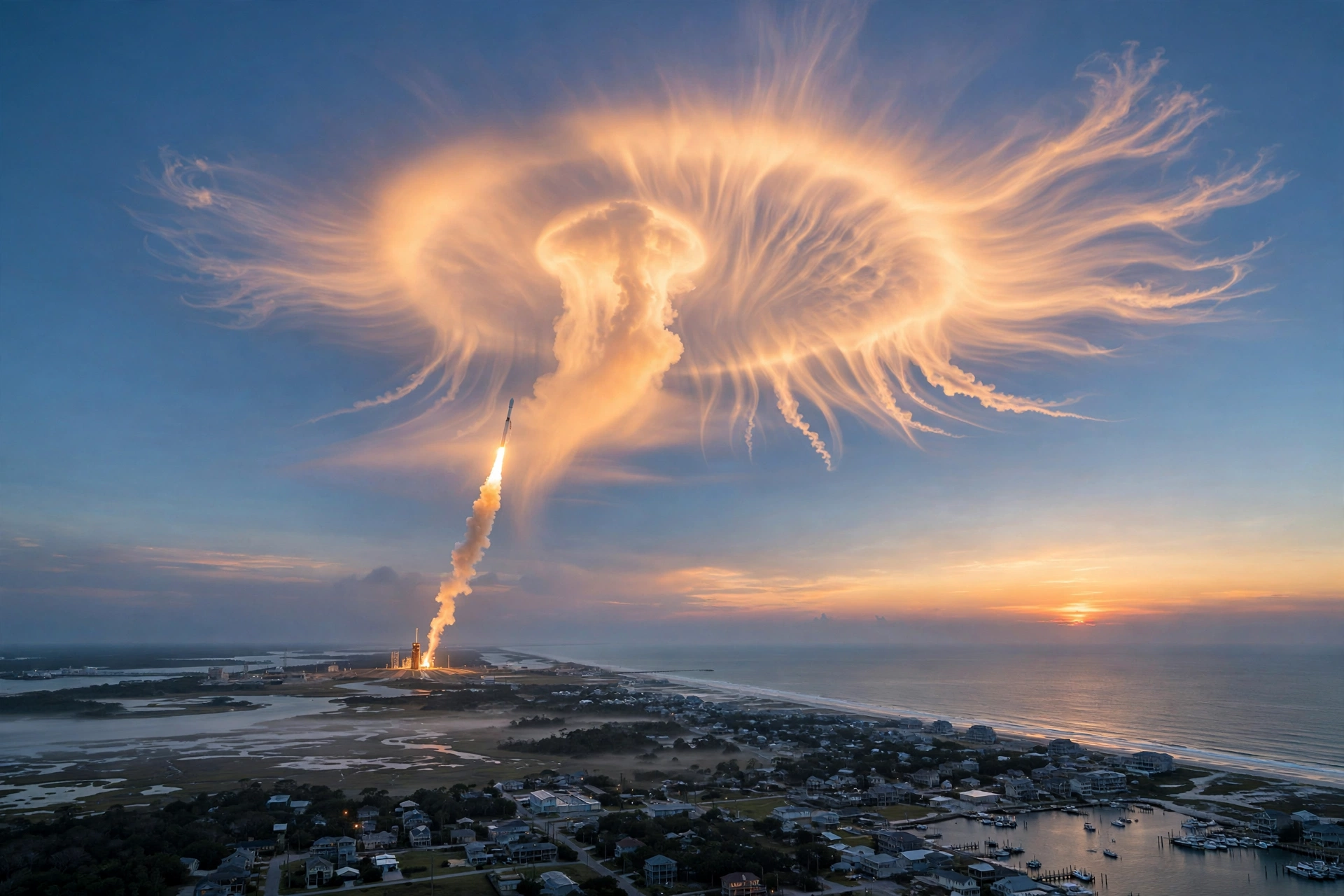
Early risers along the United States East Coast were treated to an extraordinary sight this week, when a SpaceX rocket launch at dawn produced a glowing, tentacled plume in the sky that witnesses quickly nicknamed a “jellyfish cloud.” Photographs shared from Florida to the Carolinas showed a luminous bulb of light with long, curling trails drifting beneath it, hanging in the twilight long after the rocket itself had disappeared from view. Reports of the spectacle were covered by The Guardian, whose account collected images from stunned onlookers up and down the coast.
What Exactly Is a Jellyfish Cloud?
Despite the nickname, a jellyfish cloud is not a cloud in the ordinary weather sense, and it has nothing to do with marine life. It is the exhaust plume of a rocket, expanded and illuminated under very specific lighting conditions. When a launch takes place shortly before sunrise or shortly after sunset, the ground below is still in darkness while the upper atmosphere, tens of kilometres above the surface, is already bathed in sunlight. The rocket climbs into that sunlight, and its exhaust gases expand rapidly in the thin air, forming a vast, translucent fan. Sunlight passing through the plume makes it glow against the dark sky, while the twisting trails left by the rocket’s path give it the trailing tentacles that complete the jellyfish illusion.
Because the plume forms so high up, it can be visible across an enormous area. Observers hundreds of kilometres from the launch site can see the same glowing shape, which is why reports of this week’s display came in from such a wide stretch of coastline. Pilots, sailors and early morning commuters all found themselves looking at the same phenomenon from very different vantage points.
Why Dawn and Dusk Launches Look So Different
Most launches pass with little more than a bright dot and a column of vapour for anyone beyond the immediate area. The jellyfish effect needs a precise combination of timing, altitude and clear skies. The sun must be far enough below the horizon to darken the sky for viewers on the ground, yet high enough to catch the plume once the rocket reaches the upper atmosphere. Winds at altitude then stretch and curl the exhaust, sculpting it into the rounded bell and streamers that make the sight so distinctive.
Astronomers sometimes call this the “twilight phenomenon,” and it has been recorded after launches by several agencies and companies over the decades. As launch cadences have increased, particularly from Florida’s busy spaceports, sightings have become more frequent, and each one now travels around social media within minutes. It is a reminder that covering remarkable science well matters, something we explored in our look at how science stories can find a wider online audience.
A Busy Sky Is Becoming the New Normal
SpaceX now launches at a pace that would have been unthinkable a generation ago, with Falcon rockets lifting off for satellite deployments, cargo missions and crew flights throughout the year. Many of those missions carry batches of Starlink satellites, part of a constellation that already numbers in the thousands. The result is that unusual sky events, from jellyfish plumes to long “trains” of freshly deployed satellites, are becoming a shared experience for millions of people who never set out to watch a launch at all.
That familiarity cuts both ways. Space agencies and local authorities routinely field calls after twilight launches from people who fear they have seen something unexplained, or even something dangerous. Officials generally respond the same way: check the launch schedule first. Nine times out of ten, the mystery in the sky is a rocket doing exactly what it was built to do.
How to Catch the Next One
If you live within a few hundred kilometres of a launch site, your best chance of seeing a jellyfish cloud is to watch for launches scheduled in the hour before sunrise or the hour after sunset, on mornings or evenings with clear skies. Face the direction of the spaceport, give your eyes a few minutes to adjust to the dark, and keep watching after the rocket’s bright flame fades, because the plume often becomes most impressive several minutes into the flight. A phone camera on a long exposure setting can reveal colours and structure that the naked eye only hints at, which is why the best images of this week’s event came from ordinary witnesses rather than professional photographers.
Whether this week’s display was your first jellyfish cloud or your fifth, it offered the same quiet thrill: a brief, beautiful reminder that human activity now reaches high enough, and happens often enough, to paint the dawn sky. With launch schedules showing no sign of slowing, it will not be long before the next one drifts over the coast.
