

When a product stalls, conversion rates plateau, or user feedback consistently points to confusion and friction, design leadership faces a structural question. The issue is rarely about whether design matters — most organizations already accept that it does. The more pressing question is whether the current design setup is the right one for the scale, pace, and complexity of the work ahead.
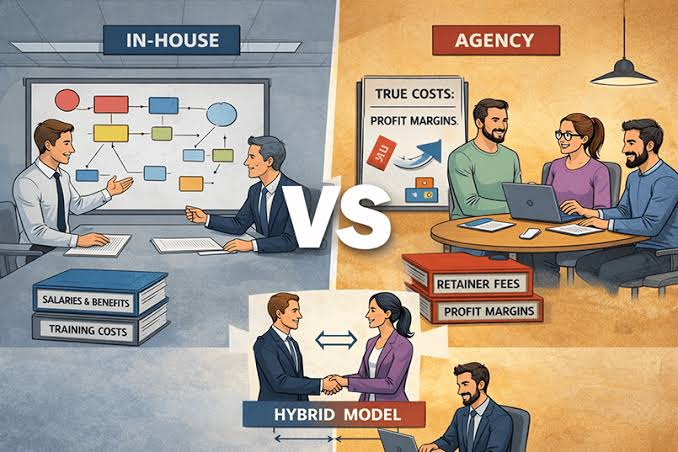
Two models dominate this decision: building and maintaining an in-house design team, or engaging an external team with focused UX expertise. Both have genuine strengths, and both carry real costs that don’t always appear in the initial budget discussion. Understanding those costs — not just in fees, but in time, consistency, and output quality — is what separates a well-informed decision from an expensive one.
What Each Model Actually Offers in Practice
A ux agency is a dedicated external team structured around user experience work across research, interaction design, usability testing, and information architecture. Unlike generalist design studios, these teams typically work across multiple industries simultaneously, which means their practitioners are exposed to a wider range of user behavior patterns, interface problems, and resolution approaches than most in-house teams accumulate over comparable timeframes. Working with a ux agency gives organizations access to this depth without having to build or sustain it internally.
An in-house design team, by contrast, is embedded within the organization. These designers attend the same meetings, absorb the same internal language, and develop an accumulated understanding of the product that external teams must actively work to replicate. That proximity has real value, particularly in highly regulated industries or products with significant institutional complexity.
The Depth Question: Specialization vs. Familiarity
In-house designers often develop strong familiarity with a specific product domain, which makes them highly efficient at incremental improvements. They understand what has been tried before, what constraints exist within the product architecture, and what internal stakeholders are likely to accept. That knowledge shortens feedback loops and reduces rework caused by organizational friction.
However, this same familiarity can become limiting. Designers who have worked within one system for an extended period may gradually lose the critical distance needed to question assumptions that have become embedded in the product. They may optimize around constraints that could and should be challenged. The design output remains technically competent but stops evolving in meaningful ways.
An external team enters without that accumulated bias. That can be an asset when an organization genuinely needs fresh thinking — particularly when user research suggests that current design patterns are producing outcomes that internal teams have normalized but that users find genuinely confusing or inefficient.
How Cost Structures Differ Across Models
The financial comparison between in-house and external UX models is more nuanced than a simple headcount calculation. An in-house design team carries costs that extend well beyond salaries — recruitment, onboarding, benefits, professional development, tooling licenses, and the management overhead required to direct and retain creative professionals. These costs are consistent and largely fixed regardless of design output volume or project intensity.
An external UX team operates on a different financial rhythm. Costs are typically tied to scope and project phases, which means spending scales with actual business need rather than headcount capacity. During periods of reduced product development activity, that flexibility reduces financial exposure. During periods of rapid development or product overhaul, that same flexibility allows organizations to expand engagement without triggering long-term employment commitments.
The Hidden Cost of Mismatched Capacity
One of the most underexamined cost factors in the in-house model is capacity mismatch. Design workload in most organizations is not consistent across the year. There are periods of high intensity — product launches, major redesigns, new feature cycles — followed by periods of lighter work. In-house teams sized for peak demand carry excess capacity during quieter periods. Teams sized for average demand become bottlenecks during peaks, which slows broader development timelines and creates downstream costs across engineering and product functions.
External teams can be engaged at the level appropriate to the current phase, which removes the capacity mismatch problem. This is a practical, operational benefit that rarely appears in high-level budget comparisons but has a measurable effect on delivery timelines and the cost of delayed product cycles.
Measuring Return Beyond Direct Fees
ROI from design investment is not straightforward to measure, but the general principle is consistent: design decisions made early in the product lifecycle are significantly less expensive to change than those identified after development or launch. Research from organizations including the Interaction Design Foundation consistently supports the finding that usability problems caught during design phases cost a fraction of what they cost when discovered post-launch.
The question then becomes which model is more likely to surface those problems early. An experienced external UX team with structured research practices may identify friction points that an internal team has developed blind spots toward. An in-house team with strong institutional knowledge may be better positioned to understand why those friction points exist and what constraints shape possible solutions. The two capabilities are complementary, which is worth noting when considering hybrid approaches.
Timeline, Accountability, and Project Governance
Project governance looks quite different depending on which model is in place. In-house teams operate within the organization’s existing management structure, which means accountability runs through internal reporting relationships. That can simplify certain decisions, but it also means that design work competes with organizational priorities, interpersonal dynamics, and internal political pressures in ways that external teams typically do not.
An external UX team works under a defined scope and timeline. There is a contractual clarity to the relationship that creates a different kind of accountability — one tied to deliverables and outcomes rather than employment relationships. This structure can be highly effective for organizations that need to move quickly or that have clear, bounded project needs.
When Ongoing Relationships with External Teams Create Stability
A common concern about external UX teams is continuity. Organizations worry that an external team will complete a project and leave, creating a gap in institutional knowledge that undermines future design work. This concern is valid in short-term engagements but less applicable to longer retainer-based relationships, which many organizations use to maintain ongoing access to UX expertise without the overhead of full-time employment.
In a sustained engagement, an external team gradually accumulates product context. They participate in research cycles, observe how users interact with the product over time, and develop familiarity with the organization’s design standards and technical constraints. The distinction between internal and external starts to blur in practice, while the structural advantages of the external model — flexibility, specialized expertise, fresh perspective — remain intact.
Situations Where In-House Teams Have a Clear Advantage
There are genuine scenarios where an in-house design team is the more appropriate structure. Organizations with highly complex regulatory environments — healthcare, financial services, certain areas of industrial software — often benefit from designers who are deeply embedded in compliance requirements and can make design decisions with an intuitive understanding of what is permissible. That level of regulatory literacy takes time to build and is difficult to transfer efficiently in project-based engagements.
Similarly, organizations in very early product stages, where design decisions are being made daily and the scope of the work is both broad and rapidly evolving, may benefit from the constant availability that an in-house team provides. When the product is still being defined and the design function is central to every decision, the overhead of coordinating with an external team may slow rather than accelerate progress.
When the Internal Model Starts to Strain
Most organizations encounter a point where the in-house model begins to show its limitations. This typically happens when design work grows more complex than the team’s current skill set comfortably covers, when the volume of work exceeds team capacity, or when the team’s output has stagnated and internal reviews are no longer producing meaningful improvements.
These are signals that the team either needs significant investment — new hires, specialized training, expanded tooling — or that supplementing with external expertise is likely to produce better results at a lower total cost. The decision is not always about choosing one model over the other permanently; it is often about knowing when each model serves the organization’s current needs.
Concluding Thoughts
The question of whether a ux agency or an in-house team delivers better ROI does not have a universal answer, because the answer depends on what an organization actually needs from its design function at a given stage of growth. The financial comparison matters, but it is secondary to the operational question of which model produces consistently good design decisions, surfaces problems early, and maintains the quality and coherence of the product experience over time.
Organizations that treat this as a permanent binary choice — agency or in-house, once and for all — often end up with a structure that fit their situation at one point but no longer reflects the current demands on their design function. The more productive frame is to evaluate both models honestly against current needs, current capacity, and current risk exposure, and to remain willing to adjust as those factors change.
For many organizations, the most effective long-term approach involves a combination: an in-house team that holds product knowledge and handles ongoing design work, supplemented by external UX expertise during periods of significant product change or when specialized research capability is needed. Understanding the strengths and limitations of each model is the precondition for making that combination work effectively.
