

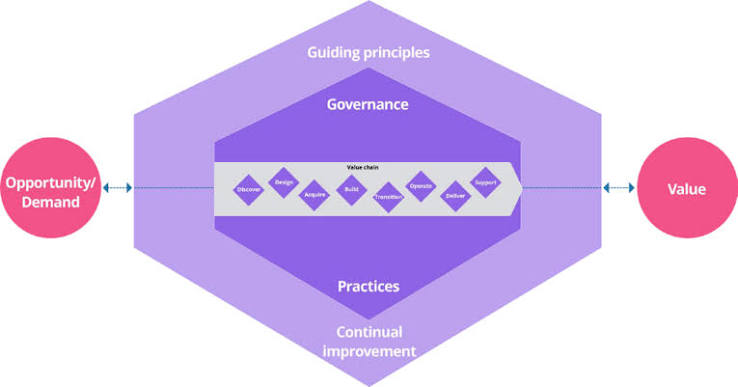
Current IT service management (ITSM) does not limit itself to only maintaining infrastructure, resolving tickets, and keeping systems running. It has now evolved to cater to fast-changing, digital-first environments where customers and stakeholders require seamless experiences. These advancements have resulted in teams needing to respond quickly. Technologies like automation, cloud computing, and artificial intelligence are also shaping the way in which service is delivered.
ITIL 5 is an important service management framework that comes together to integrate different IT services for a business’ needs. However, unlike the preceding ITIL frameworks, ITIL 5 makes management relevant for complex and AI-enabled environments. Its guiding principles help teams make practical decisions rather than enforcing rigid rules.
What Are the ITIL 5 Guiding Principles?
The seven Guiding Principles of ITIL 5 are
- Focus on Value
- Start Where You Are
- Progress Iteratively with Feedback
- Collaborate and Promote Visibility
- Think and Work Holistically
- Keep It Simple and Practical
- Optimize and Automate
While the overall ITIL 5 framework places priorities on a digital, AI-first approach to services, operations, and products, the guiding principles act as references for decision-making, which helps organizations adapt service management practices according to their specifications.
For professionals interested in learning more about modern ITSM practices, registering for the ITIL 5 Foundation Course is a great starting point to understand the concepts of ITIL and find ways to integrate them into services in modern enterprises.
Focus on Value
ITIL bases itself on the belief that all technological activities of an organization need to connect and align themselves to meaningful business and customer outcomes.
For example, an IT team should not measure their success based on how many tickets they have resolved but also needs to consider whether services and functions like user experience and employee engagement have also been enhanced.
Focusing on value enables organizations to ask themselves whether an activity would bring customer value before going ahead with it.
Start Where You Are
The framework encourages a practical approach to redesigning, enhancing, and introducing services in its workflow. Rather than introducing a new ITSM platform or service, ITIL 5 encourages teams to evaluate existing data, capabilities, and technology. If something already exists, it can become the foundation for improvement. This guiding principle can help in reducing costs while also making services more helpful.
It is also important for teams to keep in mind that large-scale service changes can be risky when implemented all at once. Instead, teams can introduce improvements in smaller increments, measure the results and feedback from those changes, and further modify their approach accordingly.
This type of approach also fits seamlessly into DevOps and Agile environments, where flexibility and continuous learning play an important role in development.
To know more about how product ownership and product management work in the Agile framework, professionals can consider signing up for the SAFe POPM Certification Course to learn how to integrate its methodology in the domain of technology and complement it with service management skills.
Collaborate and Promote Visibility
Service problems in IT often belong to more than one team. An incident can involve developers, infrastructure teams, and even business stakeholders. Collaboration helps different teams work together by understanding dependencies and striving towards achieving a common outcome. Visibility helps teams understand things like priorities, risks, and progress in an easier way. This guiding principle is especially useful in cross-functional teams.
Think and Work Holistically
Digital services of the present age are interconnected and related to one another. Changing or enhancing one component can affect services like security and business processes elsewhere. Holistic thinking enables ITSM professionals to look at individual processes as parts of the bigger and complete service experience.
Keep It Simple and Practical
Complex implementations can slow down service deliveries, making the ITSM process a lot more difficult. Things like unnecessary documentation, complicated workflows, or excessive approvals can become a hindrance to effective service management. These guiding principles enable teams to remove activities that do not provide meaningful contribution to business value.
A good ITSM workflow should help in making it easier for employees to request support, for technicians who need to resolve issues, and for managers to understand performance better.
Optimize and Automate
ITIL 5 places a heavy emphasis on digital-first environments, making automation even more important in modern-day service management. Activities like notifications, password resets, and workflows can now be done automatically.
However, automating a process involves ensuring that the process is of good quality, thus making optimizations important. Lack of optimization may lead to the creation of bad processes that are simply faster.
ITIL 5 acknowledges the growth of AI and aims for a responsible adoption of it within service management and its processes.
Conclusion
ITIL 5 helps different IT services in organizations work together to create processes and outputs of significant value. With guiding principles, service management teams improve existing capabilities, collaborate with different teams, simplify complex processes, and automate activities when it improves outcomes.
They help IT teams make better decisions in an environment where stakeholder and business priorities are constantly changing and lead to the creations of products that are more responsive, efficient, and aligned with the needs of a business.
