

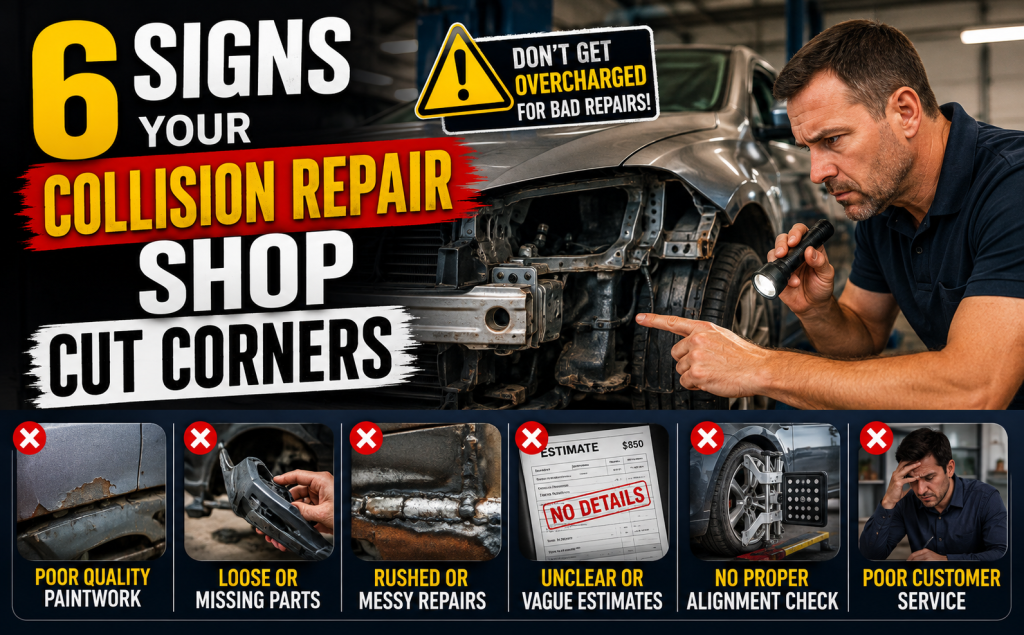
Most drivers leave a collision repair shop feeling relieved. The car looks good. The paint matches. The panels sit flush. That visible finish tells you almost nothing about whether the repair is actually safe.
The failures that matter most — compromised frame geometry, skipped sensor calibration, cleared airbag modules — leave no surface trace. They don’t show up in a parking lot walkthrough. They show up when your ADAS system fails to brake in time, or when a second impact doesn’t absorb the way it was engineered to. This post covers the six signs of corner-cutting your eyes will never catch, and exactly what to demand instead.
The Repair Looks Fine. That’s Exactly the Problem.
Consumer confidence in collision repair is almost entirely built on surface inspection: paint finish, panel gaps, mirror alignment. That framework misses the point.
The most dangerous repair failures have no visual signature. Frame rails can be misaligned within tolerances that feel normal at city speeds. Welds can pass a cosmetic inspection and still fail under torsional load. A sensor recalibrated incorrectly reads the road the same way a correctly calibrated one does — until it doesn’t.
Three hidden failure layers determine whether your repaired vehicle is actually safe:
- Frame geometry — whether structural dimensions match OEM datum specifications
- Weld integrity — whether structural welds meet OEM type, spacing, and penetration standards
- Sensor calibration — whether ADAS systems are operating on accurate, post-repair geometry
The signs covered here require knowing what to ask for, not what to look at.
Frame and Structural Integrity: What a Bent Measurement Means in a Real Crash
Modern unibody vehicles are engineered with crumple zone sequencing — a calculated collapse pattern that redirects crash energy away from the passenger cabin. That sequencing only works if post-repair frame dimensions match OEM specifications exactly.
The corner-cutting sign: a shop that skipped or rushed the frame measuring phase. Reputable shops use computerized frame alignment equipment — systems like Car-O-Liner or Chief Genesis — that map dozens of datum points against factory specifications. Shops cutting costs skip this step or rely on visual approximation.
Frame tolerances on modern vehicles are measured in millimeters. A deviation of just 3–5mm can alter crumple zone performance in a subsequent collision. That’s not a theoretical risk — it’s an engineering certainty.
A misaligned frame rarely announces itself. Technicians often compensate with steering and alignment corrections that make the car drive straight. The structural deviation stays hidden.
What to demand: A post-repair dimensional analysis report — a printed or digital readout from frame measuring equipment confirming all datum points are within OEM specification before you accept the vehicle.
The OEM Specification Gap: Why “Close Enough” Is a Safety Failure
Aftermarket structural components are not manufactured to OEM tolerance specifications. That gap matters in a crash.
OEM crash-test certifications are tied to specific part geometries. An aftermarket B-pillar may look equivalent — same steel grade, similar dimensions — but deform differently under side-impact load. That difference changes how airbag deployment sequences trigger and which parts of the cabin absorb energy.
The corner-cutting sign: a shop that substituted structural components — A-pillars, B-pillars, floor pans — with non-OEM equivalents without disclosure. This voids the crash-test validity your vehicle’s safety rating was built on.
What to demand: Every replaced structural part should carry a part number on the repair order. Cross-reference against your manufacturer’s OEM parts portal before signing the release.
Weld Quality: The Sign Hidden Behind Every Body Panel
Structural welds must match OEM weld schedules precisely — correct type, spacing, and penetration depth. No visual inspection after panel installation reveals whether that standard was met.
Two shortcuts are common under cost pressure: skipping weld-through primer before panel installation, and substituting plug welds for spot welds where OEM procedures specify otherwise. Both are invisible once panels are painted. Both compromise the structural layer they were meant to reinforce.
Improper welds can fail under torsional load — hard cornering, rough road surfaces, and certainly a secondary collision.
What to demand: Documentation confirming I-CAR Platinum or OEM welding certification for the technician who performed structural welding. A certified collision repair shop will have this on file without hesitation.
ADAS Sensors and Airbag Systems: The Corner-Cutting No One Warns You About
ADAS — Advanced Driver Assistance Systems — is the integrated network of cameras, radar, LiDAR, and ultrasonic sensors governing automatic emergency braking, lane-keep assist, blind-spot monitoring, and adaptive cruise control. Every system depends on sensors calibrated to post-repair vehicle geometry.
Corner-cutting sign #1 — Static calibration performed where dynamic is required. Many ADAS sensors require dynamic recalibration: a controlled driving procedure at specified speeds and distances using OEM equipment. Shops under time pressure substitute static target calibration. The result is a system operating on geometry that doesn’t reflect how the vehicle actually sits. It will misread distances and react incorrectly.
Corner-cutting sign #2 — Airbag control module cleared rather than replaced. After a collision, the module stores deployment data and fault codes. OEM procedures require replacement, not code clearing. NHTSA records include cases where improper SRS repair contributed to airbag non-deployment in subsequent crashes. A cleared module does not perform like a replaced one.
What to demand: A calibration completion report specifying static vs. dynamic method used, and confirmed airbag module replacement — not clearing — with a new part number on the invoice. This is standard documentation at any shop doing the repair correctly, and non-negotiable for a Tesla collision repair, where proprietary ADAS architecture requires OEM-specific equipment that most general shops don’t carry.
How to Protect Yourself Before You Sign the Release Form
The release form ends your legal leverage. Everything on this list needs to happen before you sign it.
- Request the repair order line by line. Every replaced part should carry a part number. Cross-reference structural components against OEM part numbers using your manufacturer’s public parts portal.
- Ask about ADAS calibration method. Static or dynamic? Request the calibration report as a printout — not a verbal confirmation.
- Confirm airbag module replacement by part number. “We reset the system” is not an acceptable answer. A new part number on the invoice is.
- Request the frame measuring report. If a shop doesn’t have one, the measuring step likely didn’t happen.
A shop’s response to these requests is itself diagnostic. Shops that did the repair correctly produce this documentation without friction. Shops that didn’t will struggle to produce it at all.
Why Certified Shops Operate Differently
OEM certification mandates equipment, repair procedures, and documentation workflows — and shops are audited against all three. A certified collision repair shop cannot skip frame measuring or substitute a static calibration for a dynamic one. The procedure is required. The documentation is required. The equipment must be on-site.
For Tesla collision repair specifically, OEM certification requires proprietary diagnostic tools, Tesla-approved parts sourcing, and calibration procedures built around Tesla’s sensor architecture. A non-certified shop repairing a Tesla is improvising — using general procedures on a vehicle engineered for exact ones.
Choosing a certified shop isn’t a premium decision. It’s the baseline for getting back the vehicle you had before the crash, not a cosmetically similar version of it.
Trust Spectrum Auto Inc. for Repairs That Go Beyond the Surface
At Spectrum Auto Inc., structural safety isn’t an afterthought — it’s the standard every repair is built on. Serving West Nyack, Montrose, Cortlandt, and Wurtsboro, the team brings over 30 years of experience, I-CAR® Platinum certification, and 15+ OEM certifications to every job. As a Tesla-approved collision center, Spectrum operates with mandatory documentation workflows, factory-spec equipment, and zero tolerance for shortcuts — visible or invisible. When your vehicle leaves their facility, it isn’t just restored cosmetically. It’s rebuilt to perform exactly as it was engineered to — in any situation, including the one you never see coming.
Frequently Asked Questions
- Can a frame that measures slightly off really affect my safety if the car drives straight?
Yes — and this is one of the most dangerous misconceptions in collision repair. A misaligned frame can be masked entirely with steering and alignment adjustments, making the car feel normal at everyday speeds. The problem surfaces in a subsequent crash. Crumple zones collapse in a precise sequence. Even a 3–5mm deviation from OEM datum specifications disrupts that sequence, meaning impact energy doesn’t redirect the way it was designed to. The car absorbs the crash differently — and the cabin pays the price.
- What is the difference between static and dynamic ADAS calibration, and why does it matter?
Static calibration positions the vehicle in a bay and uses fixed targets to recalibrate sensors without moving the car. Dynamic calibration requires driving at specific speeds over a set distance using OEM-specified equipment. Many ADAS systems — particularly forward-facing cameras and radar — require dynamic calibration after a collision because sensor angles are affected by changes in ride height, frame geometry, and component positioning. A shop that performs static calibration where dynamic is required returns a vehicle with sensors that are technically recalibrated but operating on incorrect reference geometry.
- How do I know if my airbag module was replaced or just cleared after a collision?
Request the repair invoice and look for a line-item airbag control module replacement with a new OEM part number. A cleared module won’t appear as a replaced part — it shows no line item, or appears as a diagnostic reset fee. If your invoice shows no module replacement following a collision where airbags deployed or the SRS light triggered, ask the shop directly. A reputable shop will provide part number verification without hesitation. If they can’t, treat that as a serious red flag.
- Does OEM certification actually prevent corner-cutting, or is it just a marketing credential?
OEM certification carries real procedural weight. Certified shops are audited against manufacturer standards covering required equipment, repair procedures, and documentation at each repair stage. Technicians must maintain active training certifications, and the shop’s tools and calibration equipment are verified during the audit. That structure removes the discretion that produces corner-cutting — a certified shop cannot perform a Tesla collision repair without Tesla-approved parts, tools, and documented calibration steps. The certification doesn’t guarantee a perfect repair, but it eliminates the conditions under which the most dangerous shortcuts occur.
